How Much Does YouTube Pay? YouTube Revenue Explained in 2026
How much does YouTube pay for 1,000 views? What about 10,000, 100,000, or 1 million views?
There isn't one fixed YouTube payment rate.
A channel's earnings can vary significantly depending on its audience, location, content category, video format, advertiser demand, seasonality, and the percentage of views that actually generate advertising revenue.
For example, two channels can receive the same number of views but earn very different amounts.
A business or finance channel with an audience in the United States may generate substantially more advertising revenue than a general entertainment channel with a similar number of views.
YouTube also monetizes long-form videos and Shorts differently.
In this guide, we'll explain how YouTube revenue works, what RPM means, how much different view counts could potentially earn, and how you can estimate the earnings of an existing YouTube channel.
Want to estimate a specific channel?
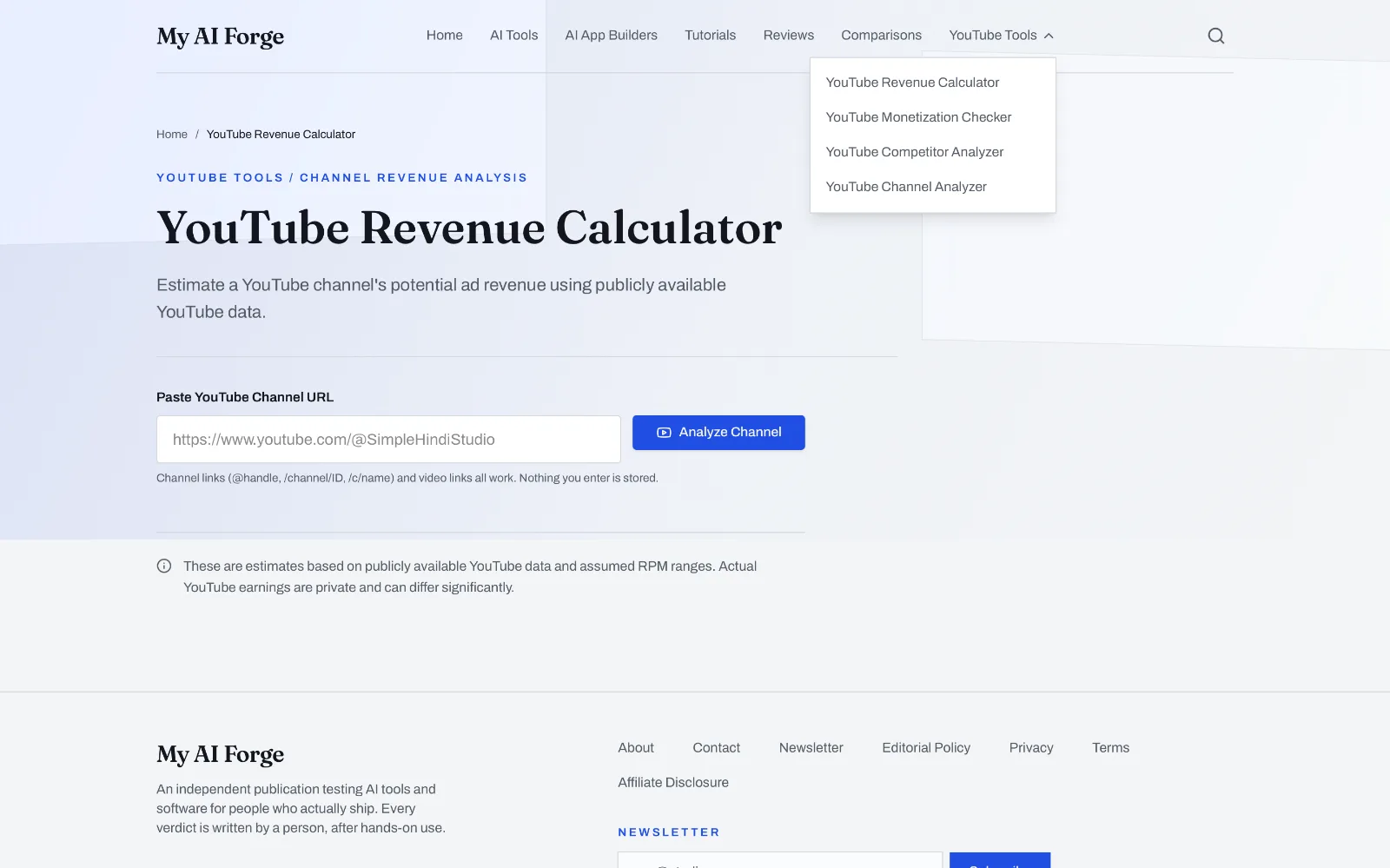
Use the "My AI Forge YouTube Revenue Calculator" to enter a YouTube channel or video URL and get an estimated revenue range based on publicly available channel data and transparent assumptions.
How Much Does YouTube Pay Per View?
YouTube does not pay creators a fixed amount for every view.
Instead, advertising revenue depends on factors such as:
Whether an ad was served
The type of advertisement
Advertiser demand
Viewer location
Content category
Video format
Watch time and viewer behavior
Whether the content is advertiser-friendly
The number of monetized views
This means there is no universal rate such as "$1 per 1,000 views" that applies to every channel.
A more useful metric for creators is RPM.
What Is YouTube RPM?
RPM stands for Revenue Per Mille, where "mille" means 1,000.
RPM represents how much revenue a creator earns per 1,000 views after YouTube's revenue share and across the creator's overall views.
A simplified calculation is:
Estimated revenue = Views ÷ 1,000 × RPM
For example, if a hypothetical channel has an RPM of $5:
1,000 views ≈ $5
10,000 views ≈ $50
100,000 views ≈ $500
1,000,000 views ≈ $5,000
These are illustrative examples, not guaranteed YouTube rates.
Actual RPM can be considerably lower or higher depending on the channel.
This is why using a single "YouTube pays X dollars per 1,000 views" figure can be misleading.
How Much Money Can 1,000 YouTube Views Make?
There is no guaranteed amount.
Using hypothetical RPM scenarios:
Views | $2 RPM | $5 RPM | $10 RPM |
|---|---|---|---|
1,000 | $2 | $5 | $10 |
10,000 | $20 | $50 | $100 |
100,000 | $200 | $500 | $1,000 |
500,000 | $1,000 | $2,500 | $5,000 |
1 million | $2,000 | $5,000 | $10,000 |
Again, these numbers are simply examples showing how RPM affects revenue.
Your actual RPM may be very different.
How Much Does YouTube Pay for Shorts?
YouTube Shorts work differently from traditional long-form videos.
Ads in the Shorts Feed are handled through a revenue-sharing system rather than simply attaching an individual advertisement to a particular Short.
YouTube pools revenue from ads shown between Shorts and then allocates revenue to monetizing creators based on eligible engaged views and other factors. Creators receive 45% of the revenue allocated to them from the Shorts Creator Pool.
Because the monetization model is different, Shorts should not be estimated using the same RPM assumptions as long-form videos.
This is one reason why a channel can receive millions of Shorts views without generating the same advertising revenue that millions of long-form views might produce.
YouTube also excludes certain views from Shorts revenue calculations, including artificial or fake views and certain non-original or policy-ineligible views.
Want to know how much a specific YouTube channel could earn? Enter its channel URL into our free YouTube Revenue Calculator.
YouTube Shorts vs. Long-Form Revenue
The two formats have fundamentally different monetization systems.
Long-form videos
Long-form videos can earn through Watch Page advertising and YouTube Premium revenue.
For creators who accept the Watch Page Monetization Module, YouTube says creators receive 55% of net revenues from ads displayed or streamed on their public videos on the Watch Page.
YouTube Shorts
Shorts revenue comes primarily from ads shown between videos in the Shorts Feed.
Revenue is pooled and allocated among eligible creators. Creators receive 45% of their allocated share.
Therefore, you shouldn't take a long-form RPM and simply apply it to Shorts views.
What Determines YouTube Revenue?
Several factors can affect how much a channel earns.
1. Audience location
Where your viewers live can have a major impact on advertising economics.
Advertisers may value audiences differently depending on the market, competition and purchasing power.
This means two channels with identical view counts can have very different RPMs.
2. Content category
Some topics attract more advertiser competition than others.
For example, advertisers may have different budgets and objectives when targeting audiences interested in:
Finance
Business
Software
Technology
Education
Gaming
Entertainment
Lifestyle
This doesn't mean one category has a guaranteed RPM.
It simply means advertiser demand can vary between audiences and topics.
3. Long-form vs. Shorts
Long-form Watch Page monetization and Shorts Feed monetization operate differently.
As a result, you should calculate them separately instead of treating every YouTube view equally.
4. Viewer behavior
Not every view results in the same advertising opportunity.
YouTube explains that ads are not guaranteed to appear on every monetized video or every viewing session. Ad availability and other factors influence whether ads are shown.
5. Advertiser-friendly content
Content must meet YouTube's advertiser-friendly requirements to be eligible for advertising revenue.
A video can receive substantial traffic while still having limited or no advertising revenue if it doesn't qualify for certain monetization opportunities.
6. Seasonality
Advertising demand can change throughout the year.
For example, advertiser spending can increase around major shopping periods or other commercially important times.
Therefore, a channel's RPM can change from month to month even when its content and audience remain relatively consistent.
YouTube Revenue Is More Than Advertising
Advertising isn't the only way YouTubers can make money.
Once creators are eligible for the appropriate YouTube Partner Program features, they may have access to several monetization options.
These can include:
Watch Page advertising
Shorts Feed advertising
YouTube Premium revenue
Channel memberships
Super Chat
Super Stickers
Super Thanks
Shopping
YouTube also lists other ways creators can make money, including Shopping and YouTube Premium revenue.
There can also be revenue outside YouTube's built-in monetization system, such as:
Sponsorships
Affiliate marketing
Digital products
Online courses
Consulting
Merchandise
Brand partnerships
For some creators, these additional income streams can eventually become more important than advertising revenue.
How Much Does YouTube Pay Monthly?
Monthly YouTube income depends on how many monetized views a channel generates and the effective RPM during that period.
A simplified example:
Imagine a hypothetical long-form channel generates 500,000 monthly views.
If its effective RPM were:
$3 RPM
Estimated advertising revenue:
500,000 ÷ 1,000 × $3 = $1,500
At:
$7 RPM
The same number of views would produce:
500,000 ÷ 1,000 × $7 = $3,500
At:
$12 RPM
It would be:
500,000 ÷ 1,000 × $12 = $6,000
The channel didn't change its number of views.
The difference comes from the assumed RPM.
That's why estimating YouTube income requires more than simply looking at total views.
Can You Calculate YouTube Revenue From Subscribers?
Not accurately.
Subscribers are useful for understanding the size of a channel, but subscribers themselves don't directly determine advertising revenue.
A channel with 100,000 subscribers might receive only a small number of views on a particular video.
Another channel with 20,000 subscribers could potentially receive hundreds of thousands or millions of views.
For revenue estimation, recent view activity is generally more useful than subscriber count alone.
Can YouTube Revenue Be Calculated From Total Channel Views?
Not accurately for monthly revenue.
This is an important distinction.
Suppose a channel has accumulated:
100 million lifetime views.
That number tells you how much traffic the channel has received over its lifetime.
It does not tell you how many views the channel is generating this month.
Using:
Lifetime views × RPM
to calculate monthly revenue would therefore produce a misleading result.
A better estimate should consider recent view activity, video publishing frequency, content format and reasonable RPM assumptions.
How to Estimate a YouTube Channel's Revenue
A useful channel-level estimate can follow several steps.
Step 1: Find the channel
Enter the YouTube channel URL.
Step 2: Analyze recent public data
Look at publicly available information such as:
Subscriber count
Total channel views
Public video count
Recent video views
Publishing dates
Video format
Recent upload activity
Step 3: Estimate recent viewing activity
Instead of treating lifetime views as monthly views, estimate the channel's recent viewing activity from its recent videos.
Step 4: Separate content formats
Where possible, distinguish between:
Long-form videos
Shorts
They should not be treated as having identical monetization economics.
Step 5: Apply a range of RPM assumptions
Instead of presenting one fake-precise number, use a range such as:
Low → Typical → High
This gives the reader a more realistic understanding of the uncertainty.
Try the My AI Forge YouTube Revenue Calculator
If you want to estimate the potential earnings of a real YouTube channel, you don't need to manually calculate everything.
Use the My AI Forge YouTube Revenue Calculator.
Enter a YouTube channel URL or supported YouTube video URL and the tool analyzes publicly available YouTube information to generate an estimated revenue range.
It can help you understand:
Estimated monthly advertising revenue
Estimated annualized revenue
Recent channel performance
Recent video activity
Long-form vs. Shorts considerations
Revenue assumptions
Important: the tool provides an estimate, not the channel owner's actual AdSense earnings.
Actual YouTube revenue is private and can only be accurately viewed by the channel owner through YouTube/Google's creator systems.
Does YouTube Revenue Calculator Show Actual Earnings?
No.
A public YouTube URL does not provide access to a creator's private YouTube Analytics or AdSense revenue.
Public information can be used to create an estimated revenue range, but it cannot reveal the creator's actual earnings.
This distinction matters because actual revenue can depend on information that isn't publicly available, including monetized playbacks, advertiser demand, revenue adjustments and other account-level data.
YouTube itself says that earnings are not guaranteed and depend on revenue generated from viewers watching monetized content.
How Much Do YouTubers Make From Sponsorships?
Sponsorship income is completely separate from YouTube's advertising revenue.
A creator may earn money from a brand even when the brand deal has nothing to do with YouTube's advertising system.
Sponsorship pricing can depend on:
Average views
Audience location
Niche
Engagement
Audience demographics
Content format
Campaign requirements
Brand
Creator reputation
Therefore, subscriber count alone isn't enough to determine sponsorship income.
A channel with a smaller but highly targeted audience can sometimes be attractive to advertisers.
How Much Does YouTube Premium Pay Creators?
YouTube Premium is another potential revenue source for eligible creators.
When a YouTube Premium subscriber watches monetized creator content, creators can receive a share of subscription revenue.
This is separate from the standard advertising calculation.
YouTube lists Premium revenue as one of the ways creators can earn within the YouTube Partner Program.
Do You Need 1,000 Subscribers to Make Money on YouTube?
For full advertising revenue through the YouTube Partner Program, YouTube currently lists a requirement of:
1,000 subscribers
plus either:
4,000 qualified public watch hours from long-form videos in the last 365 days, or
10 million qualified public Shorts views in the last 90 days
along with the other YPP requirements and policy compliance.
Meeting the numerical thresholds alone does not guarantee acceptance into YPP. YouTube reviews channels for compliance with its monetization policies.
YouTube has also announced changes to YPP thresholds beginning February 1, 2027, so creators should check the current requirements in YouTube Studio before making monetization decisions.
The Bottom Line: How Much Does YouTube Pay?
There is no universal YouTube payment rate.
A better way to think about YouTube income is:
YouTube revenue = views × monetization economics
For long-form videos, RPM can provide a useful way to estimate potential earnings.
For Shorts, the revenue-sharing system works differently, so long-form RPM assumptions should not simply be applied to Shorts.
The biggest factors include:
Number of views
Audience location
Content category
Long-form vs. Shorts
Advertiser demand
Viewer behavior
Seasonality
Advertiser-friendly status
Other monetization sources
If you want a quick estimate for a specific channel, try the My AI Forge YouTube Revenue Calculator and enter the channel URL.
Just remember: the result is an estimate based on public information, not the creator's private YouTube earnings.
Frequently Asked Questions
How much does YouTube pay for 1,000 views?
There is no fixed payment for 1,000 views. Your effective RPM determines the approximate revenue, and RPM can vary significantly between channels.
How much does YouTube pay for 100,000 views?
It depends on the channel's RPM. For example, at a hypothetical $5 RPM, 100,000 views would correspond to approximately $500. This is an illustrative calculation, not a guaranteed YouTube payment.
How much does YouTube pay for 1 million views?
At a hypothetical $5 RPM, 1 million views would correspond to approximately $5,000. Actual earnings can be much lower or higher depending on the channel.
Do Shorts pay less than long-form videos?
Shorts use a different revenue-sharing system from long-form videos. YouTube pools revenue from ads shown between Shorts and distributes it among eligible creators. Therefore, Shorts should not be evaluated using the same RPM assumptions as long-form content.
Can I see another YouTuber's actual earnings?
No. A public YouTube channel does not expose the owner's private YouTube Analytics or AdSense revenue. Third-party tools can only provide estimates.
Does YouTube pay based on subscribers?
No. Subscribers don't directly determine advertising revenue. Views, audience characteristics, monetization eligibility and other factors are much more relevant to revenue.
What is RPM on YouTube?
RPM means Revenue Per Mille, or revenue per 1,000 views. It is a useful metric for understanding how much revenue a creator earns relative to their views.
Is YouTube income guaranteed?
No. YouTube explicitly states that there are no guarantees regarding how much or whether a creator will be paid.
Where can I calculate a YouTube channel's estimated earnings?
You can use the My AI Forge YouTube Revenue Calculator to enter a YouTube channel or supported video URL and get an estimated revenue range based on publicly available information and transparent assumptions.