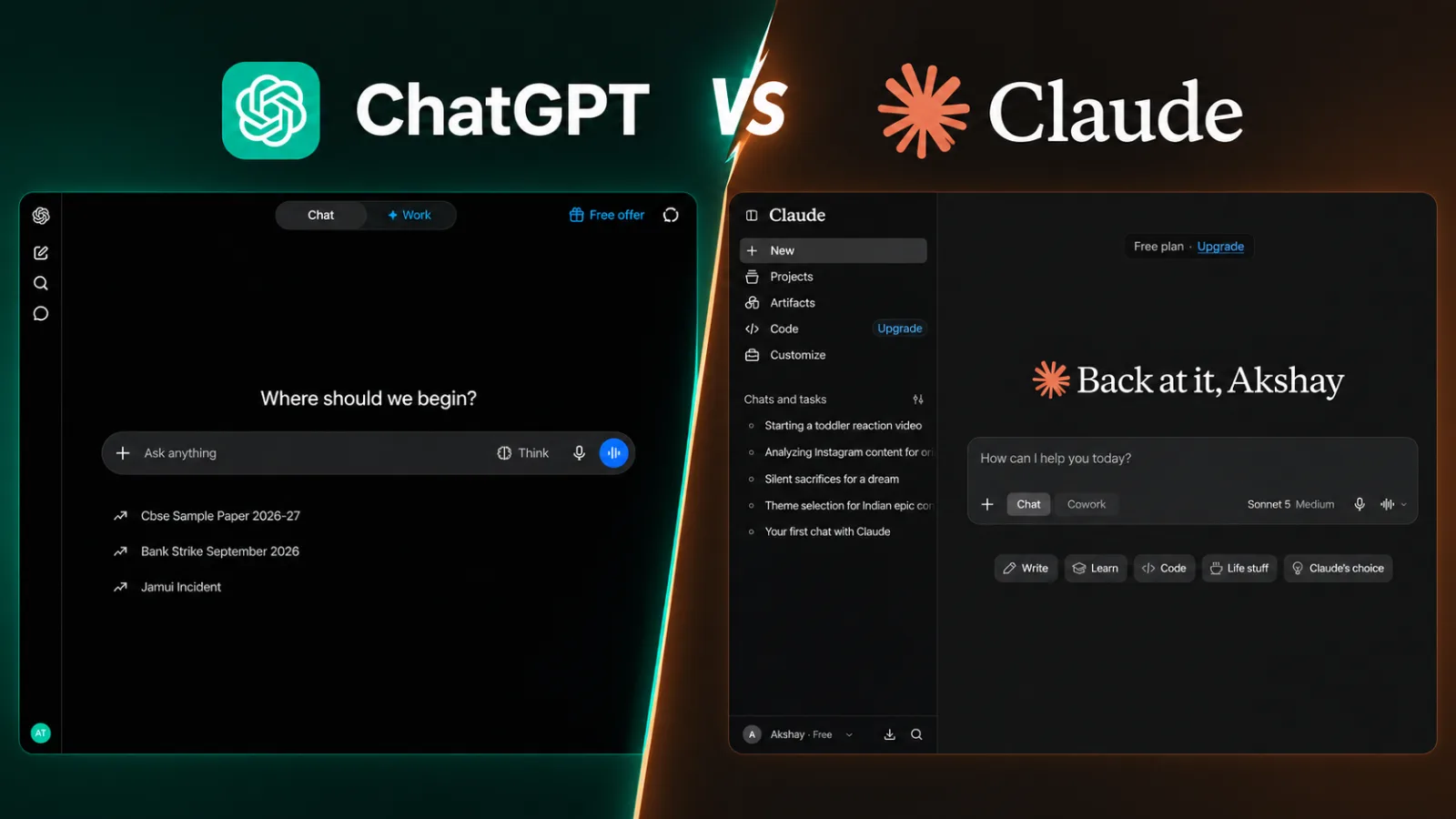
ChatGPT vs Claude: Which AI Assistant Is Better in 2026?
If you're choosing an AI assistant in 2026, two names are likely to come up again and again: ChatGPT and Claude.
Both can help with writing, coding, research, brainstorming, document analysis, and everyday work. But they are not identical. Their features, model options, workflows, and integrations are different enough that the better choice depends largely on what you want to do with AI.
In this guide, we'll compare ChatGPT vs Claude across writing, coding, research, long documents, images, productivity, pricing, and everyday use.
The goal isn't to declare one AI universally better. Instead, we'll look at where each platform can fit different types of users.
ChatGPT vs Claude: Quick Comparison
Feature | ChatGPT | Claude |
|---|---|---|
AI assistant | Yes | Yes |
Writing and editing | Excellent | Excellent |
Coding | Strong | Strong |
Research | Deep Research and web tools | Research and web search |
Image generation | Yes | Not primarily an image generator |
Image analysis | Yes | Yes |
Projects/workspaces | Projects | Projects |
AI coding tools | Codex | Claude Code |
Long-document work | Strong | Strong |
Custom workflows | GPTs, Projects, Work features | Projects, Artifacts, integrations |
Free plan | Yes | Yes |
Paid plans | Multiple options | Pro, Max and business plans |
Best fit | Broad AI ecosystem | Writing, coding and focused knowledge work |
Features and plan availability can change, so check the official product pages before purchasing a subscription.
What Is ChatGPT?
ChatGPT is OpenAI's AI assistant. It can be used for conversations, writing, coding, research, analysis, image generation, document work, brainstorming, and many other tasks.
The current ChatGPT experience includes the GPT-5.6 model family, with model availability varying by plan. OpenAI also provides different reasoning levels and higher-capability options for eligible paid users.
One of ChatGPT's biggest advantages is that it has developed into more than a chatbot. It combines AI models with tools and features designed for different workflows.
For example, ChatGPT can help users create and edit images, analyze uploaded files, organize ongoing work in Projects, perform research, and work with coding tools.
This makes ChatGPT particularly interesting if you want one AI platform that can handle many different types of tasks.
What Is Claude?
Claude is Anthropic's AI assistant.
Claude focuses heavily on writing, reasoning, coding, document analysis, and professional knowledge work. Anthropic offers several Claude model tiers designed for different levels of capability, speed, and cost.
Claude also includes features such as Projects, Artifacts, web search, Research, and Claude Code.
Projects allow users to organize conversations and documents around a particular subject. Artifacts provide a dedicated workspace for creating things such as documents, code, diagrams, and interactive outputs.
Claude Code is designed specifically for software development and can work with codebases through a terminal-based workflow.
Anthropic's current Claude lineup includes newer Opus and Sonnet models, with Claude Opus 5.5 announced in September 2026.
ChatGPT vs Claude for Writing
Writing is one of the most common reasons people use AI assistants.
Both ChatGPT and Claude can help with:
Blog posts
Emails
Social media content
Reports
Scripts
Product descriptions
Rewriting
Summaries
Brainstorming
Editing
The difference is often more about workflow and personal preference than a simple quality gap.
ChatGPT can be useful when writing is part of a larger workflow. For example, you could research a topic, create an outline, generate images, analyze source material, and then edit the final article within the same ecosystem.
Claude is also well suited to long-form writing and editing. Users who want to work with large amounts of text, detailed instructions, and structured documents may find its Projects and document-oriented workflow useful.
For bloggers, marketers, and content creators, it makes sense to test both with the same writing prompt rather than relying only on general comparisons.
ChatGPT vs Claude for Coding
Both platforms have become significant coding assistants.
ChatGPT can help developers:
Write code
Debug errors
Explain unfamiliar code
Refactor applications
Design software architecture
Analyze files
Generate tests
Work through technical problems
OpenAI also provides Codex for software development workflows.
Claude has a particularly strong developer-oriented ecosystem around Claude Code. Anthropic describes its newer models as being designed for coding, tool use, agents, and long-running professional work.
Claude can be especially useful when working through large codebases and multi-step development tasks.
ChatGPT, meanwhile, can be attractive to developers who want coding combined with a broader collection of AI capabilities such as research, image generation, file analysis, and other tools.
For serious development work, the practical choice may depend on your IDE, terminal workflow, codebase size, preferred tools, and the specific model available on your plan.
ChatGPT vs Claude for Research
AI research has changed significantly. Instead of simply asking a chatbot a question, users can now use AI tools to investigate a topic, analyze information, and organize findings.
ChatGPT provides research-oriented capabilities alongside its broader ecosystem. It can be useful for researching markets, products, technologies, businesses, and complex topics.
Claude also offers web search and Research features designed for information gathering and analysis.
For either platform, users should remember an important rule: AI-generated research still needs verification.
An AI assistant can misunderstand a source, use outdated information, or present an uncertain claim too confidently. For important research, always check primary sources and recent documentation.
ChatGPT vs Claude for Long Documents
Both platforms can work with large amounts of information, although exact limits and capabilities depend on the model and plan.
This can be useful for:
Research papers
Business documents
Books
Legal documents
Technical documentation
Software repositories
Meeting transcripts
Reports
Claude has long emphasized large-context workflows, and its current Sonnet models advertise very large context windows for supported applications.
ChatGPT also supports file uploads and Projects, allowing users to organize files, instructions, chats, and ongoing work.
If long-document processing is important to you, don't judge only by advertised context size. The quality of retrieval, reasoning, instructions, and final output matters just as much.
ChatGPT vs Claude for Images
This is one area where the platforms differ considerably.
ChatGPT includes built-in image generation and editing. Users can create images from prompts, edit existing images, change backgrounds, add details, and request different aspect ratios.
That makes ChatGPT useful for creators who want both text and visual generation in one place.
Claude can analyze images and work with visual information, but it isn't positioned primarily as a general-purpose image generation platform.
If your workflow includes creating blog graphics, social media images, thumbnails, concepts, or other AI-generated visuals, ChatGPT provides a more integrated experience.
ChatGPT vs Claude for Productivity
For everyday productivity, both platforms can act as general-purpose AI assistants.
You can use either to:
Summarize meetings
Draft emails
Create plans
Brainstorm ideas
Analyze documents
Explain complicated topics
Create checklists
Generate reports
Organize information
Help with research
ChatGPT's Projects feature lets users keep chats, files, and instructions together around a particular project.
Claude also offers Projects, allowing users to create dedicated workspaces containing relevant conversations and documents.
The best choice here often comes down to which interface and workflow you find easier to use consistently.
ChatGPT vs Claude: Pricing
Pricing changes regularly, so this is one area where you should check the official pricing pages before subscribing.
Both ChatGPT and Claude offer free access, although free plans have usage limits and may not include every feature or model.
ChatGPT has several consumer and business-oriented plans, with access to different models and capabilities depending on the subscription.
Claude offers Free, Pro, Max, Team, and Enterprise options, with different usage limits and features.
Don't choose a subscription based purely on the monthly price.
Instead, consider what you actually need.
If you only occasionally ask questions, a free plan may be enough. If you're using AI every day for writing, coding, research, or business work, the additional tools and usage limits of a paid plan may become more important.
Which One Should You Choose?
Rather than asking "Which is better?", consider what you want your AI assistant to do.
Choose ChatGPT if you want:
A broad all-in-one AI platform
Built-in image generation
General-purpose AI assistance
Research and analysis tools
Coding assistance
Projects and organized workflows
A large ecosystem of AI features
AI for both creative and technical work
Consider Claude if you want:
Strong writing and editing workflows
Advanced coding assistance
Long-document work
Claude Code
Projects for organizing knowledge
Artifacts for creating and working with outputs
A focused AI assistant for professional knowledge work
These are not strict rules. Both platforms can perform many of the same tasks, and their capabilities continue to change.
Can You Use ChatGPT and Claude Together?
Absolutely.
In fact, you don't necessarily have to choose one.
Many AI users can benefit from using different models for different stages of a workflow.
For example, you could use one assistant to brainstorm ideas, another to critique the draft, and another tool to verify information.
A content creator might use ChatGPT to research and structure a video, Claude to review the script, and a specialized AI video tool to produce the final video.
A developer might use both assistants to approach a difficult coding problem from different perspectives.
The key is to focus on the workflow rather than treating AI assistants like competing products where only one can be used.
ChatGPT vs Claude: The Bottom Line
ChatGPT and Claude are both powerful AI assistants, but they have different ecosystems and strengths.
ChatGPT stands out as a broad AI platform combining conversation, reasoning, research, coding, image generation, file analysis, Projects, and other tools.
Claude is particularly focused on writing, coding, long-context work, professional knowledge tasks, Projects, Artifacts, and developer workflows through Claude Code.
For someone who wants a versatile AI platform with many capabilities in one place, ChatGPT may fit naturally into that workflow.
For someone whose primary needs revolve around writing, coding, documents, and focused professional work, Claude may be worth testing.
But the most useful test is your own workflow.
Take the same five or ten tasks you regularly perform and run them through both platforms. Compare the accuracy, writing quality, reasoning, speed, usability, and amount of editing required.
AI models are evolving quickly. A comparison that is accurate today can become outdated after a major model or product update.
That's why the best approach is not to pick an AI assistant based solely on a headline comparison. Choose the platform that consistently helps you complete your actual work with less friction.
Frequently Asked Questions
Is ChatGPT better than Claude?
There isn't one answer for every user. ChatGPT and Claude have overlapping capabilities but different tools, models, and workflows. Your preferred use case should determine which platform fits you better.
Is Claude better for coding?
Claude is highly focused on coding and agentic software development, particularly through Claude Code. ChatGPT also provides strong coding capabilities and Codex. The best fit depends on your development workflow and the tools you use.
Is ChatGPT better for images?
ChatGPT has built-in image generation and editing capabilities. This makes it particularly useful if image creation is an important part of your AI workflow.
Can Claude analyze images?
Yes. Claude supports image analysis, allowing users to provide visual information as part of their conversations.
Can I use ChatGPT and Claude for free?
Both offer free access, although free users have usage limits and may not receive every model or feature available on paid plans.
Which is better for content creators?
Both can be useful. ChatGPT offers a broader collection of creative tools, including image generation, while Claude can be useful for writing, editing, research, and long-form content workflows.
Should I pay for both ChatGPT and Claude?
Not necessarily. Start with the free versions and identify which tasks you perform most often. If one platform consistently provides value that justifies its subscription, consider upgrading. Power users may find value in having access to both.
Last updated: September 2026
AI models and pricing change frequently. Always check the official ChatGPT and Claude websites for the latest model availability, features, and subscription pricing before making a purchase.