
How Much Does YouTube Pay per 1,000 Views? RPM by Niche & Country in 2026
How much does YouTube pay for 1,000 views?
There is no single answer.
A YouTube channel with 100,000 views can earn substantially more or less than another channel with the same number of views. The biggest factors include the type of content, viewer location, video format, advertiser demand, seasonality, and how many views are actually monetized.
For example, a finance channel attracting viewers in the United States can have a very different RPM from a gaming channel whose audience is primarily in India.
That is why looking only at total views can be misleading.
In this guide, we'll break down estimated YouTube RPM by niche and country, explain the difference between CPM and RPM, and show what 10,000, 100,000, and 1 million views could potentially earn.
Important: The figures in this article are estimated industry benchmarks for comparison purposes, not guaranteed YouTube earnings. YouTube does not publish a fixed RPM rate by niche or country. Actual earnings can vary substantially between channels.
What Is YouTube RPM?
RPM stands for Revenue Per Mille, meaning revenue per 1,000 views.
YouTube defines RPM as the amount a creator earns per 1,000 views after YouTube's revenue share. It can include advertising revenue as well as other YouTube revenue sources such as YouTube Premium, memberships, Super Chat, and Super Stickers.
A simplified calculation is:
Estimated revenue = Views ÷ 1,000 × RPM
For example, if your RPM is $5:
1,000 views = approximately $5
10,000 views = approximately $50
100,000 views = approximately $500
1 million views = approximately $5,000
These are mathematical examples, not guarantees.
Your actual YouTube Analytics RPM can be higher or lower.
YouTube RPM vs CPM: What's the Difference?
CPM and RPM are often confused.
CPM represents what advertisers pay for 1,000 ad impressions before YouTube's revenue share.
RPM is a creator-focused metric that reflects revenue after YouTube's revenue share and includes views that weren't necessarily monetized.
This is why you shouldn't simply take a CPM number from an advertising website and multiply it by your views.
Not every YouTube view generates an advertisement.
A viewer may not receive an ad because there isn't suitable ad inventory, the video isn't eligible for certain ads, the viewer has YouTube Premium, or other targeting and monetization factors apply.
For creators trying to estimate earnings, RPM is generally the more useful number.
How Much Does YouTube Pay per 1,000 Views?
For long-form videos, a broad RPM range can run from under $1 to well above $10, depending heavily on the niche and audience.
Some highly commercial niches can generate considerably higher RPMs, while entertainment-oriented content can be much lower.
Here is an illustrative 2026 benchmark:
Niche | Estimated RPM — Tier 1 audience |
|---|---|
Personal Finance & Investing | $8–$30+ |
Insurance & Legal | $8–$30+ |
Business & Entrepreneurship | $5–$20 |
Make Money Online | $5–$20 |
Real Estate | $5–$18 |
Technology & AI | $4–$15 |
Education | $3–$10 |
Health & Fitness | $3–$10 |
Travel | $2–$8 |
Automotive | $3–$12 |
Gaming | $1–$6 |
Entertainment | $1–$5 |
Comedy | $1–$5 |
Music | $0.50–$3 |
General Vlogging | $1–$6 |
These ranges are illustrative benchmarks, not official YouTube rates. Third-party 2026 industry estimates similarly show finance, insurance and legal content among the higher-paying categories, while gaming and entertainment tend to have lower advertiser rates.
The same niche can produce very different results depending on the audience.
YouTube RPM by Country: Why Geography Matters
One of the biggest factors affecting YouTube advertising revenue is where your viewers are located.
Advertisers don't value every advertising market equally.
YouTube itself explains that CPM can change when the geography of a channel's viewers changes because advertisers compete differently for audiences in different locations.
For simplicity, creators and marketers often talk about informal audience "tiers."
These are not official YouTube categories.
Tier 1: Higher-value advertising markets
Common examples include:
United States
Canada
United Kingdom
Australia
New Zealand
Some Western European markets
These audiences often have stronger advertiser demand and higher purchasing power.
Tier 2: Mid-to-high advertising markets
Examples can include:
Germany
France
Netherlands
Sweden
Norway
Denmark
Switzerland
Austria
Ireland
Singapore
United Arab Emirates
Actual RPM can vary significantly between these countries and even between individual channels.
Tier 3: Lower-cost advertising markets
Examples can include:
India
Indonesia
Philippines
Bangladesh
Pakistan
Vietnam
Many Latin American markets
Many African markets
Again, these are broad marketing categories rather than official YouTube classifications.
A channel in one of these countries can still earn strong RPM if it attracts viewers from higher-value advertising markets.
Estimated YouTube RPM by Audience Tier
For a broad comparison, you can think about long-form RPM roughly like this:
Audience | General RPM Range |
|---|---|
Higher-value/Tier 1 | $4–$20+ |
Mid-value/Tier 2 | $2–$10 |
Lower-value/Tier 3 | $0.50–$5 |
These ranges overlap intentionally.
A technology channel with a mostly US audience could potentially generate a much higher RPM than a general entertainment channel with the same audience.
Likewise, an Indian channel targeting US viewers can potentially have a very different RPM from an Indian channel whose viewers are primarily in India.
Your audience's location matters more than the creator's physical location.
How Much Does YouTube Pay in India?
There is no fixed "Indian YouTube RPM."
A creator in India might have an audience consisting primarily of Indian viewers, or they might create English-language content watched heavily by viewers in the US, UK, Canada and Australia.
Those two channels can have very different RPMs.
For example, consider two hypothetical channels:
Channel A
Creator: India
Audience: 80% India
Niche: General entertainment
Long-form RPM: potentially around $0.50–$2.50
Channel B
Creator: India
Audience: 70% US/UK/Canada
Niche: Business/AI
Long-form RPM: potentially several dollars per 1,000 views and potentially much higher
These are illustrative examples, not guaranteed rates.
This is one reason targeting a specific international audience can matter when choosing a YouTube niche.
Which YouTube Niches Pay the Most?
Generally, advertisers pay more when a viewer represents a valuable potential customer.
That's why commercial categories such as finance, insurance, legal services, business, software and real estate can command stronger advertising demand.
1. Finance & Investing
Finance is frequently one of the highest-paying YouTube categories.
Topics can include:
Investing
Credit cards
Personal finance
Taxes
Banking
Insurance
Retirement
Loans
A viewer researching a financial product can be highly valuable to advertisers.
2. Business & Entrepreneurship
Business content can also attract valuable advertisers.
Examples include:
Starting a business
SaaS
Entrepreneurship
Marketing
Business software
Freelancing
Online businesses
This is particularly interesting for creators because the advertising revenue can be supplemented by software affiliate commissions and sponsorships.
3. Technology & AI
Technology and AI can have strong commercial potential because advertisers include software companies, SaaS platforms, hardware manufacturers and business services.
Examples:
AI tools
AI software
SaaS
Productivity software
Coding
Cybersecurity
Cloud services
For My AI Forge, this is especially relevant because AI/business content can combine advertising revenue with affiliate revenue.
4. Real Estate
Real estate can attract advertisers selling:
Mortgages
Property services
Insurance
Real estate platforms
Investment products
However, RPM varies significantly by geography.
5. Education
Education can have solid advertising demand, particularly for:
Online courses
Professional certifications
Career training
Universities
Software training
Lower-Paying Niches Don't Mean You Can't Make Money
A lower RPM doesn't automatically mean a bad YouTube business.
Gaming, entertainment, comedy and music can generate enormous audiences.
For example:
Channel A
1 million views × $2 RPM = approximately $2,000
Channel B
200,000 views × $10 RPM = approximately $2,000
The second channel needs only one-fifth as many views to produce the same illustrative advertising revenue.
This is why RPM and audience quality matter alongside view volume.
Shorts vs Long-Form: A Major Difference
You should also be careful when comparing Shorts and traditional videos.
YouTube Shorts use a different monetization model from Watch Page videos.
For Watch Page advertising, YouTube says creators receive 55% of net ad revenue under the Watch Page Monetization Module. For Shorts, creators receive 45% of the revenue allocated to them from the Shorts Creator Pool.
Because of the different monetization system and huge volume of Shorts views, Shorts RPM is generally much lower than long-form RPM.
That means:
1 million Shorts views ≠ 1 million long-form views in revenue.
A creator might need substantially more Shorts views to generate the same advertising revenue as a long-form channel.
What Determines Your YouTube RPM?
Your niche and country are important, but they aren't the only factors.
Viewer geography
Where your viewers live can significantly affect advertising demand.
Niche
Finance and business advertisers may have very different customer acquisition economics from entertainment advertisers.
Video length
Longer videos can provide more opportunities for monetization, including mid-roll ads when eligible.
Seasonality
Advertising demand changes throughout the year.
YouTube specifically notes that advertiser bidding can increase around periods such as the holiday season.
Audience
Advertisers may pay differently depending on viewer demographics, interests and purchasing intent.
Advertiser-friendly content
Some content may receive limited advertising or no ads.
Monetized views
Not every view results in an advertisement.
YouTube Revenue Isn't Just Ad Revenue
Advertising is only one way creators can make money.
YouTube also supports monetization methods such as:
YouTube Premium
Channel memberships
Super Chat
Super Stickers
Super Thanks
Shopping
YouTube says creators can receive 70% of net revenue from memberships, Super Chat, Super Stickers and Super Thanks under its Commerce Product Module.
Creators can also earn money outside YouTube through:
Sponsorships
Affiliate marketing
Digital products
Courses
Consulting
Services
Merchandise
These aren't included in a standard advertising RPM calculation.
Why Your YouTube Revenue Can Change Every Month
Suppose your channel gets exactly 100,000 views every month.
You might still earn different amounts.
For example:
January:
100,000 views × $4 RPM = $400
March:
100,000 views × $6 RPM = $600
November:
100,000 views × $8 RPM = $800
The number of views didn't change.
The RPM did.
Advertiser demand, audience geography, content mix, monetized views and seasonal advertising budgets can all affect the result.
Don't Estimate Monthly Revenue From Lifetime Views
This is one of the biggest mistakes people make when estimating a YouTube channel's earnings.
Suppose a channel has:
100 million lifetime views.
You cannot simply multiply:
100,000,000 × RPM
and call that the channel's monthly income.
Those views accumulated over years.
A better estimate looks at recent viewing activity, recent uploads, video performance and reasonable RPM assumptions.
That's also why public YouTube channel revenue estimates should always be treated as estimates.
Private YouTube Analytics contains information that isn't available through a normal public channel lookup.
Want to Estimate a YouTube Channel's Revenue?
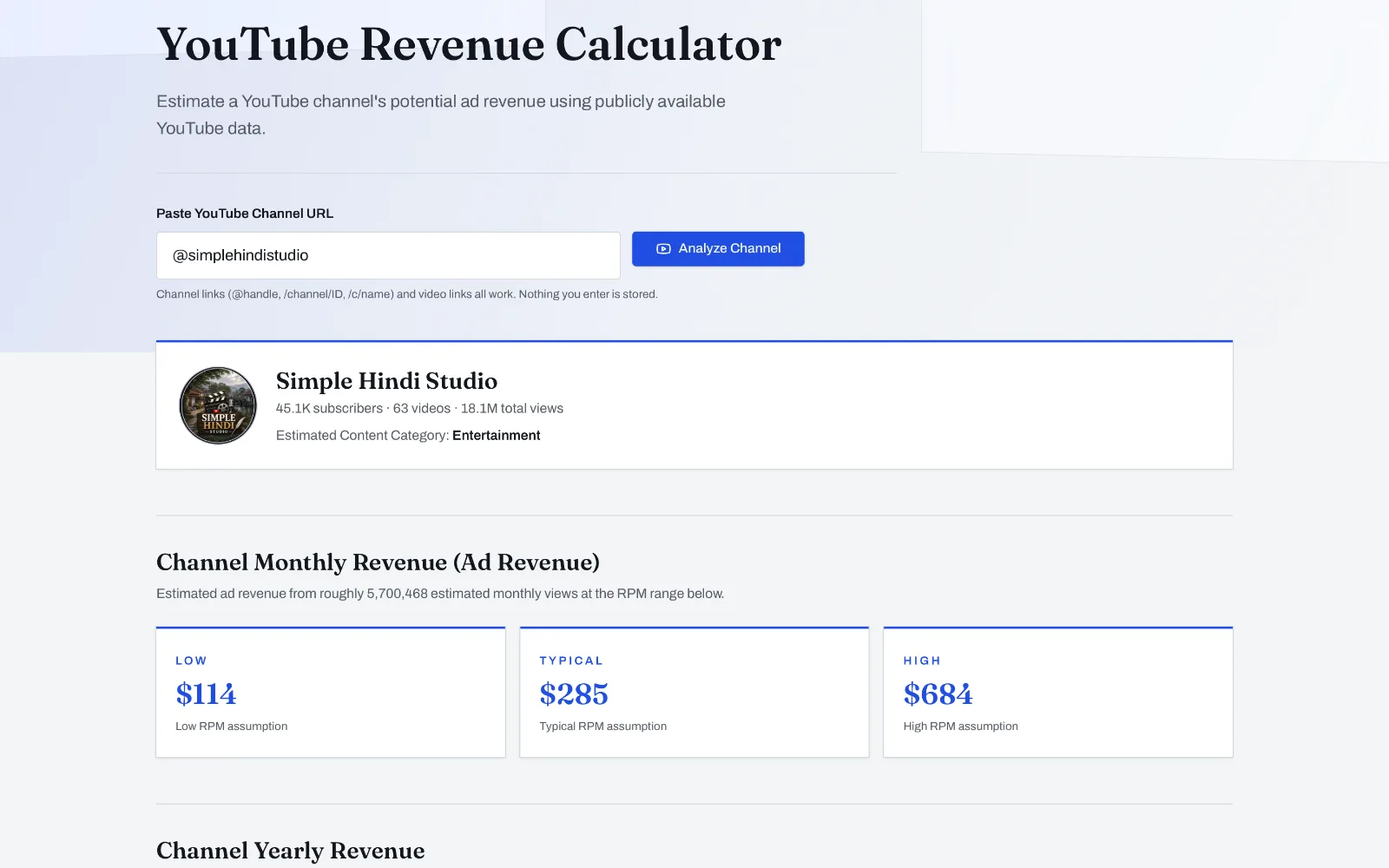
Instead of guessing based on subscriber count alone, you can use the My AI Forge YouTube Revenue Calculator.
Paste a YouTube channel or video URL to analyze publicly available channel information and generate an estimated revenue range based on recent performance and transparent assumptions.
[Analyze a YouTube Channel →]
The result is an estimate—not the channel owner's actual YouTube Analytics or AdSense revenue.
The Bottom Line
So, how much does YouTube pay?
There is no universal answer.
A channel might earn less than $1 per 1,000 views, while a high-value channel with a strong audience in premium advertising markets can potentially earn many dollars—or considerably more—per 1,000 views.
The biggest variables are:
Niche
Viewer country
Long-form vs Shorts
Advertiser demand
Monetized views
Audience characteristics
Seasonality
Video content and advertiser suitability
The most important lesson is this:
100,000 views from the right audience can be worth much more than 100,000 views from a lower-value advertising market.
And that's why serious YouTube creators should focus on more than just getting views. The goal is to build an audience that is valuable to advertisers, sponsors, affiliate partners and your own business.
YouTube itself does not guarantee a particular level of earnings, and actual revenue should always be checked in YouTube Analytics rather than estimated from generic online RPM tables.
FAQ
How much does YouTube pay for 1,000 views?
There is no fixed amount. Depending on niche, audience geography and other factors, 1,000 monetized long-form views could generate anything from well under $1 to many dollars. High-value niches and audiences can produce substantially higher RPMs.
Which YouTube niche has the highest RPM?
Finance, investing, insurance, legal, business and some software-related categories are generally considered among the higher-value advertising niches. However, there is no official YouTube ranking of RPM by niche.
Does country affect YouTube RPM?
Yes. YouTube says advertiser demand varies by geography, which can cause CPM and ultimately creator revenue to change when the location of viewers changes.
Does the creator's country determine RPM?
Not directly. The location of your viewers is much more important for advertising-market demand than simply where the creator lives.
Do Shorts pay less than long-form videos?
Shorts use a different revenue-sharing system and generally produce much lower revenue per view than traditional long-form videos. YouTube currently gives creators 45% of their allocated Shorts Creator Pool revenue, compared with 55% of net Watch Page ad revenue for eligible long-form content.
How much does YouTube pay for 1 million views?
It depends on RPM. At a hypothetical $5 RPM, 1 million views would equal approximately $5,000. At $2 RPM, it would be approximately $2,000. These are examples, not guaranteed earnings.
Can I know another YouTuber's exact revenue?
Usually no. A channel's actual YouTube Analytics and AdSense revenue are private. Public tools can only estimate earnings using publicly available information and assumptions.
Editorial note for My AI Forge: I would keep the RPM tables explicitly labeled "estimated 2026 benchmarks"throughout the article. Don't present the niche/country numbers as official YouTube rates. YouTube's own documentation confirms that RPM varies with monetized views and revenue sources, while geography affects advertiser demand.
This also makes the article a strong companion to your YouTube Revenue Calculator without making the article itself look like an advertisement.